Understanding the Hermès Béton Togo Leather Birkin 30 with Gold Hardware and the Rise of High-End "Superfakes"
The Hermès Birkin is widely regarded as the ultimate pinnacle of luxury fashion, exclusivity, and status. Among the vast array of sizes, leathers, and colorways produced by the historic French fashion house, specific combinations capture the imagination of collectors worldwide.
One of the most sought-after contemporary specifications is the Birkin 30 in Béton Togo leather paired with Gold Hardware (GHW). However, the astronomical retail barriers, lengthy waiting lists, and skyrocketing secondary market valuations for genuine pieces have fueled an underground shadow market: the era of the high-end "superfake."
The Allure of Béton Togo with Gold Hardware
To understand why this specific combination is heavily replicated, one must first examine its aesthetic appeal.
The Color Béton: Introduced as part of Hermès’ neutral palette, Béton (French for "concrete") is a sophisticated, pale off-white shade with subtle gray and warm undertones. It is distinct from stark white or cream, offering a modern, earthy minimalist aesthetic that shifts gently depending on the lighting.
Togo Leather: Crafted from baby calfskin, Togo is famed for its natural pebble grain, durability, and resistance to scratching. It holds the structured silhouette of a Birkin 30 brilliantly while retaining a soft, tactile hand-feel that develops a rich patina over time.
Gold Hardware: While palladium (silver-toned) hardware gives Béton a crisp, icy modernism, Gold Hardware introduces a warm, classic contrast. The juxtaposition of cool, muted concrete-gray leather against polished, rich gold-plated hardware creates an eye-catching luxury statement.
Because authentic pieces of this exact configuration are notoriously difficult to secure directly from a boutique—often requiring a substantial "purchase history"—it has become a prime target for high-tier replica manufacturers.
What is a "Superfake"?
Unlike the crude, easily identifiable knockoffs sold on street corners decades ago, a modern superfake is an elite-tier counterfeit. These items are produced in specialized underground workshops—frequently centered in manufacturing hubs like Guangzhou, China—using advanced sourcing and meticulous craftsmanship.
High-end superfakes of a Birkin 30 do not rely on cheap plastics or printed synthetics. Instead, underground ateliers go to extreme lengths to mimic every single physical property of an authentic Hermès bag:
Imported Leathers: Top-tier replica makers source genuine French calfskin, attempting to replicate the exact grain, weight, and tannage of Hermès Togo leather.
Hand-Stitching: True Hermès bags are constructed using a signature saddle stitch executed by hand with waxed linen thread. High-end superfakes often replicate this exact dual-needle hand-stitching technique, making visual inspection via photographs nearly useless.
Precious Metal Plating: Rather than cheap base metals that chip or discolor, superfake hardware is often heavy brass plated with real gold, mimicking the cool heft and luster of genuine components.
The Fine Line: How Superfakes Differ from Authentics
Despite the staggering degree of accuracy achieved by top-tier workshops, subtle microscopic and tactile discrepancies remain. Professional authenticators and seasoned collectors look to several specific markers to distinguish a Béton Togo Birkin 30 superfake from the real article: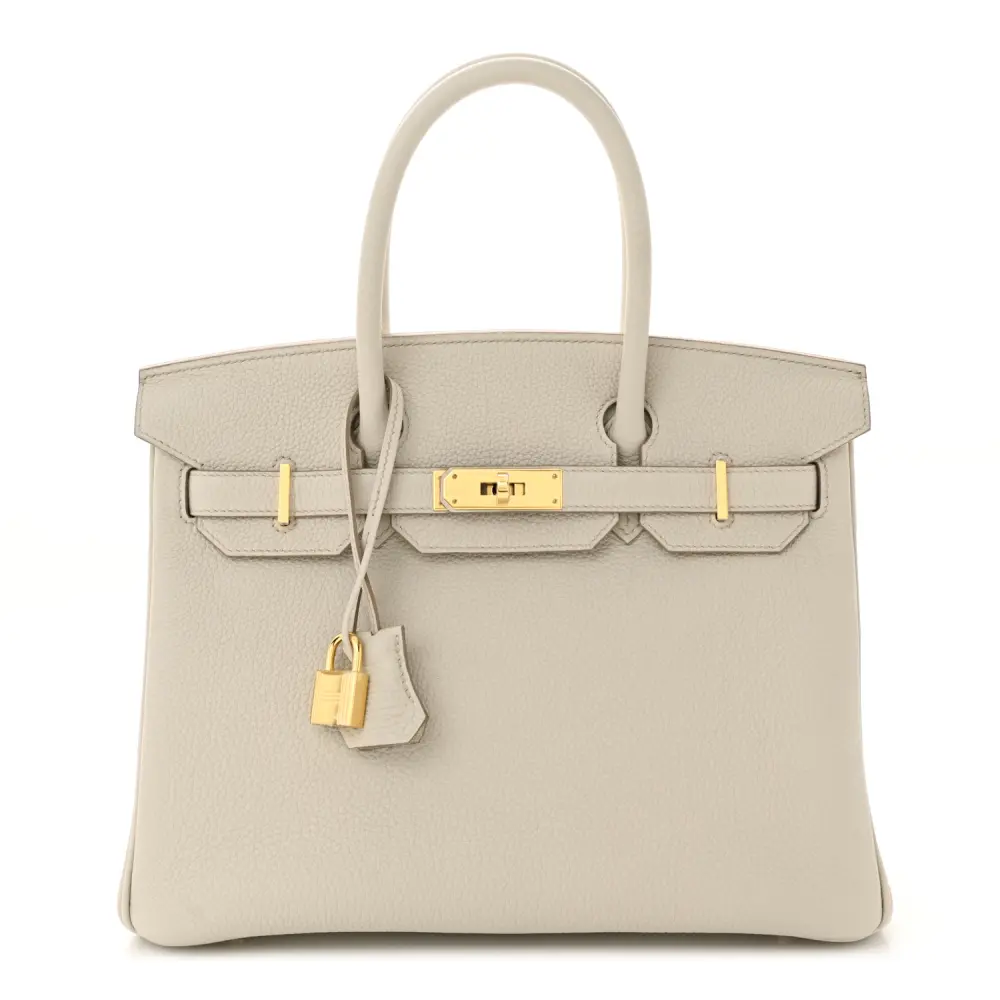
1. The Heat Stamp
The foil-embossed or blind-stamped "HERMÈS PARIS MADE IN FRANCE" logo located under the front flap is one of the hardest elements to replicate perfectly. Authentic Hermès stamps are pressed with exact thermal pressure, causing the letters to sink organically into the pebble grain of the Togo leather. Superfakes frequently suffer from micro-imperfections in the font spacing, depth, or foil sheen under a jeweler's loupe.
2. Hardware Micro-Engravings & Polishing
On an authentic Birkin, the hardware components—such as the touret (donut) and the plaque—feature precise, crisp hand-engravings where the letters have slightly rounded, sloping trenches rather than laser-etched, sharp-edged industrial cuts. Furthermore, the internal metal mechanics of the turnlock should feature smooth bevelling designed to prevent wear and tear on the leather straps.
3. Handle Architecture
The handles of a Birkin 30 are meticulously shaped by hand. On a genuine bag, the front handle is structurally engineered to be fractions of a millimeter shorter than the back handle to accommodate the natural folding of the flap. Mass-produced or even high-tier replica factories occasionally overlook this nuance, resulting in symmetrical handles that do not lie quite right when the bag is closed.
4. Interior Chèvre Lining
A Togo Birkin 30 is typically lined with Chèvre mysore (goatskin), which features a tighter, more uniform grain than the exterior calfskin. The texture, suppleness, and color saturation of the interior leather lining are frequent giveaways for replica factories trying to cut production costs.
The Economic and Ethical Implications
The proliferation of Béton Togo Birkin 30 superfakes has created a profound crisis within the luxury secondary market. High-tier replicas, which can cost anywhere from $800 to over $2,000 to produce, routinely bypass AI authentication algorithms and occasionally dupe inexperienced human resellers.
For consumers, the market split reflects a growing ideological divide:
Purists and Investors argue that a Birkin is not merely a handbag, but an investment vehicle, a piece of art history, and a symbol of heritage craftsmanship backed by a lifetime maintenance warranty at Hermès spa services.
Disillusioned Luxury Buyers, fatigued by artificial scarcity games, boutique quotas, and hyper-inflated resale markups, increasingly view superfakes as a rational consumer rebellion against a predatory luxury pricing model.
Summary Table: Authentic vs. Superfake Indicators
| Feature | Authentic Hermès Birkin 30 | High-Tier Superfake |
| Leather Sourcing | Proprietary French tanneries (Togo calfskin) | High-grade imported European calfskin with customized grain stamping |
| Construction | Single artisan hand-stitched saddle method | Meticulously hand-stitched to mimic artisanal tension |
| Hardware Finish | Real gold-plated solid brass with smooth bevels | Gold-plated heavy alloy; occasionally shows micro-machining flaws |
| Blind Stamp | Deep, organic impression dependent on year/craftsman | Laser or press stamp; sometimes uniform to a fault |
| Market Access | Extremely restricted (Boutique quota or high secondary markup) | Readily accessible via specialized private overseas channels |
Final Thoughts
The Hermès Béton Togo Leather Birkin 30 with Gold Hardware remains an undisputed masterpiece of modern design. As long as the barrier to entry for genuine pieces remains exceptionally high, the market for ultra-sophisticated superfakes will continue to thrive, forcing both buyers and authenticators to look closer than ever before.


Comments
Post a Comment